
Advanced Insights Platform for airport security checkpoint optimization
July 9, 2026
Inside AIP: The best features according to the developer
We sat down with Michiel Schipper, one of the developers behind Point FWD’s Advanced Insights Platform (AIP). We talked about the platform’s functionalities, how it was developed and his top three features. From linking performance monitoring with capacity modeling to demand-driven lane planning and technology validation, Michiel explains where AIP adds practical value within the security checkpoint.

Michiel Schipper
Consultant
Michiel@pointfwd.com

Michiel’s top 3 features
Connecting performance monitoring with capacity modeling creates a consistent, airport-specific operational baseline. It helps security teams identify where the checkpoint is constrained and test which changes are needed to improve performance.
Demand-driven lane scheduling brings modeling into daily operations. AIP uses passenger demand, measured performance, lane setups and service targets to calculate the right combination of open lanes, staffing and timing throughout the day.
Validating checkpoint upgrades before implementation allows airports to test technology choices and lane configurations before making operational or investment decisions. Teams can compare equipment, setups and scenarios on throughput, staffing, subprocess capacity and efficiency.
Want to feel in control of your checkpoint operations?
Request free demo access and find out for yourself how intuitive AIP really is.

For readers who have not seen AIP yet, what is the platform designed to do?
Michiel: AIP gives users one environment to monitor current operations, model changes, and plan lanes and staffing against passenger demand. It combines capabilities that are often spread across different tools and data sources. AIP can be used across strategic and operational use cases: to project future checkpoint designs, monitor performance during trials, identify strengths and improvement areas, support continuous optimization cycles, and automatically generate lane plans.
The starting point is always the airport’s own operation. Every airport has different passenger profiles, equipment, staffing models, procedures and performance requirements. AIP allows users to bring those factors together and assess how they interact across the checkpoint.
You helped develop the platform. What interested you most about the challenge?
Michiel: Airport security is challenging to model because every decision affects several parts of the checkpoint operation. Changing equipment can shift the bottleneck, while adding staff at one position may have little impact if another subprocess is already at capacity. Passenger profiles and cabin baggage also change throughout the day.
The challenge was to make those dependencies visible without creating a tool only technical modelers could use. We wanted security professionals to build, test, and compare their own checkpoint scenarios. It was a great opportunity to be a part of that.

Which three AIP features would you highlight first for airport security teams?
Michiel: I would start with the connection between performance monitoring and capacity modelling. Airports and security providers often discuss lane performance, staffing requirements or bottlenecks using different data sets and definitions. That can make it difficult to agree on the starting point.
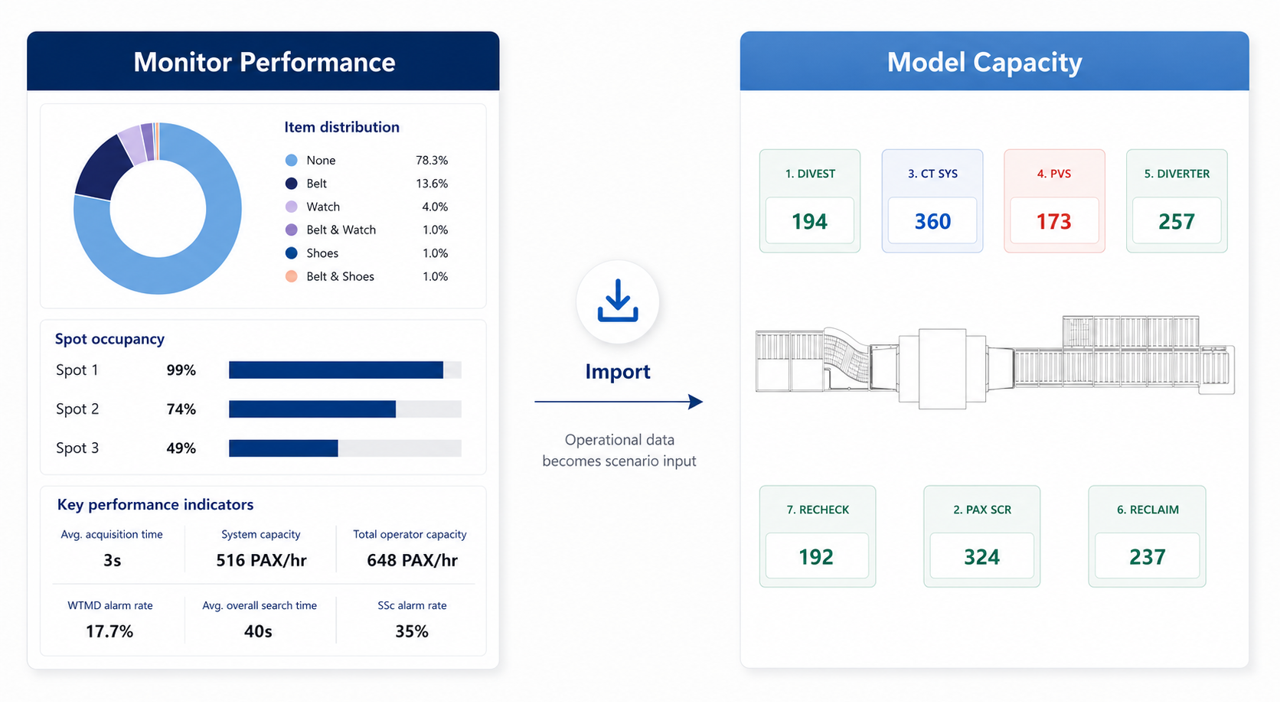
AIP creates a consistent, airport-specific operational baseline. It combines screening equipment data, passenger flow measurements, and operational observations in the performance dashboard. The modeling module then uses that validated baseline to test which changes are needed to reach a target.
Can you give a practical example of how that works?
Michiel: Finding a starting point for optimization is a good example. We call that the operational baseline. An airport may know its overall lane throughput, but without knowing where the bottleneck is, it’s difficult to decide what needs to change. AIP helps by modelling the capacity of each subprocess and showing where the operation is constrained.
If, for example, divest turns out to be the bottleneck, AIP can show which process variables have the biggest impact. Teams can test what happens if divest occupancy increases, or if average divest time decreases. This makes the discussion more practical: instead of only seeing that throughput should improve, the airport can see which part of the process needs attention and what effect an improvement would have.
You mention airport-specific data quite often. How does that data actually get into AIP?
Michiel: That’s a fair question, because the quality of the output depends on the quality of the input. AIP is designed to integrate with virtually all data that can be exported from screening equipment and related systems. That includes data from X-ray machines, CT scanners, tray return systems and other checkpoint technologies.
We complement system data with operational measurements from our Checkpoint Insight Tool (CIT). CIT captures process-level data such as processing times, occupancy rates, and passenger behavior, including elements not recorded directly by machines. Combining system integrations with CIT measurements allows the model to reflect the real operation as closely as possible.
Another favorite capability of yours is demand-driven lane scheduling. What makes this your second favorite feature of AIP?
Michiel: Because it connects modelling directly to daily operations. Airport conditions change throughout the day, and a single average lane capacity does not capture that. Passenger mix, flight type and Items Per Passenger all influence processing times. The Lane Scheduler accounts for these variations and creates a daily plan with the right combination of open lanes, staffing, and timing for each peak.
How does the scheduler prevent airports from simply opening more lanes than necessary?
Michiel: The scheduler works with operational constraints and service targets. Airports enter passenger demand, the capacity of different lane setups, staffing options, and requirements such as maximum queue size or a 95th percentile waiting-time target.
AIP calculates the lane and staffing plan needed to meet those conditions. Because the output uses the airport’s own demand and measured performance, airports can avoid unnecessary lane openings and overstaffing during quieter periods while protecting service levels during peaks. This can reduce recurring operational costs.
Your third favorite feature is validating checkpoint upgrades before implementation. Why does this stand out?
Michiel: Technology upgrades may promise performance gains, but the outcome depends on how the technology is configured within the full checkpoint process. APIDS is a useful example. The question is how a specific configuration affects image analysis, operator workload, lane capacity, and the location of the bottleneck.
In AIP, users can configure their own lane, select the screening equipment they want to assess, and compare machines across multiple setups. Using the same airport-specific inputs, they can compare each scenario with the current setup and with one another on throughput, staffing, and subprocess capacity and the efficiency of these scenarios
Can AIP also help translate an operational improvement into a business case?
Michiel: Yes. Once the operational impact is modeled, the return on investment module connects it to annual passenger demand, lane schedules, and staffing requirements.
For an APIDS scenario, the model can compare the current baseline with the proposed setup over a full year. It calculates how the configuration affects staffing requirements and full-time equivalents, which can then be assessed against the investment cost. This shows whether the operational gain justifies the investment, what the expected ROI period may be, and helps airports avoid major investments without a clear view of the expected effect.
What do you ultimately want airport teams to gain from using AIP?
Michiel: I want airports to be able to take control of their own data and use it to build, test and validate their own checkpoint models. They already know their operation better than anyone. AIP gives them the tools to translate that knowledge into quantified scenarios.
For me, the value is that teams can compare options before making a decision, understand exactly what drives performance, and then check whether the expected improvement was actually achieved. That makes discussions more objective and gives airports a much stronger basis for design, planning and investment decisions.
Optimize your security process
Want to see what AIP looks like in practice? Book a short demo and we will walk you through the platform.