
Advanced Insights Platform: More than an airport security dashboard
Advanced Insights Platform: more than just another dashboard
We know what you are thinking: not another dashboard. Airport security teams already work with dashboards, reports, operational data, equipment outputs and planning tools. So, when a new platform is introduced, the obvious question is: what makes this one different?
The answer is simple. AIP is designed to support validated checkpoint decisions end-to-end and based on real operational evidence, not just to visualize checkpoint data.

Michael Verhage
Senior Consultant
Michael@pointfwd.com

Robin van Gemert
Managing Director
Robin@pointfwd.com

Article highlights:
Operational evidence behind every decision: AIP brings equipment data, passenger flow monitoring and observed process data together, so checkpoint decisions are based on the same operational reality.
The missing layer between data and performance: Standard dashboards may show queues or throughput changes, but AIP helps uncover variables such as process times, tray content, alarm resolution and reclaim behavior.
Validated choices before time and budget are committed: Teams can test lane setups, equipment configurations, staffing models and demand-driven schedules against their own checkpoint baseline before changes are made.
Want to feel in control of your checkpoint operations?
Request free demo access and find out for yourself how intuitive AIP really is.
Beyond airport security dashboards
A traditional dashboard helps you see what happened. That is useful, but in a security checkpoint the next question is often more important. Why did it happen? Where in the process did capacity drop? Was the issue linked to passenger behavior, staffing, equipment, CONOPs, lane setup or a combination of factors? That is where AIP goes further.
Many dashboards show high level system data or passenger flow information. They can indicate that queues are building, that waiting times are increasing or that lane throughput is decreasing. But that view often misses the operational layer between system logs and real-world checkpoint performance.
AIP is built around the checkpoint process itself, specifically for the AvSec industry. It doesn’t just display operational data from screening equipment but combines it with passenger flow monitoring and behavioral process data into one performance monitoring environment. This means teams can track checkpoint KPIs, identify bottlenecks and drill down into subprocess details from the same evidence base.
The difference is in the level of explanation. With Checkpoint Insight Tool, part of the AIP platform, teams can capture time-based and behavioral process data directly on the checkpoint floor. This includes variables such as passenger types, process times, tray content, alarm resolution, divest position occupancy and reclaim times. These are often the variables that explain why performance changes, but they are not usually visible in standard dashboards or equipment outputs. That means AIP does not only show that performance is changing. It helps teams understand where the change happens, which subprocess is affected and which operational variable may be driving it.

From manufacturer specs to operational validation
Understanding where performance is lost is the first step. The next step is being able to test what happens when you change the operation. In many security transitions, lane design starts with manufacturer specifications, generic performance assumptions or average throughput figures. Those inputs are useful, but they do not always reflect how a specific airport, passenger profile or checkpoint process performs in practice.
AIP allows teams to model from their own operational baseline. Airports can work with the machines of their choice and matching specs but also test how those machines perform within a specific lane setup, staffing model and CONOPs. This means the equipment and the configuration around it can be tested against the airport’s own data before a decision is made. In AIP, modelling is more than a theoretical design exercise. It allows security teams to test whether a setup is expected to work in their real checkpoint environment.
“You can’t connect the dots looking forward; you can only connect them looking backwards.”
Model, validate and simulate optimizations first
Checkpoint optimization is an ongoing cycle of learning and improving as it becomes visible how passenger flows, processes, staffing and technology interact in the reality of the operation. With the help of AIP (Advanced Insights Platform), we map checkpoint performance, monitor KPIs, identify bottlenecks and use operational data in static modelling to understand the impact of specific process parameters. It turns data into the insight airports need before changing lane setups, staffing models or operational processes.
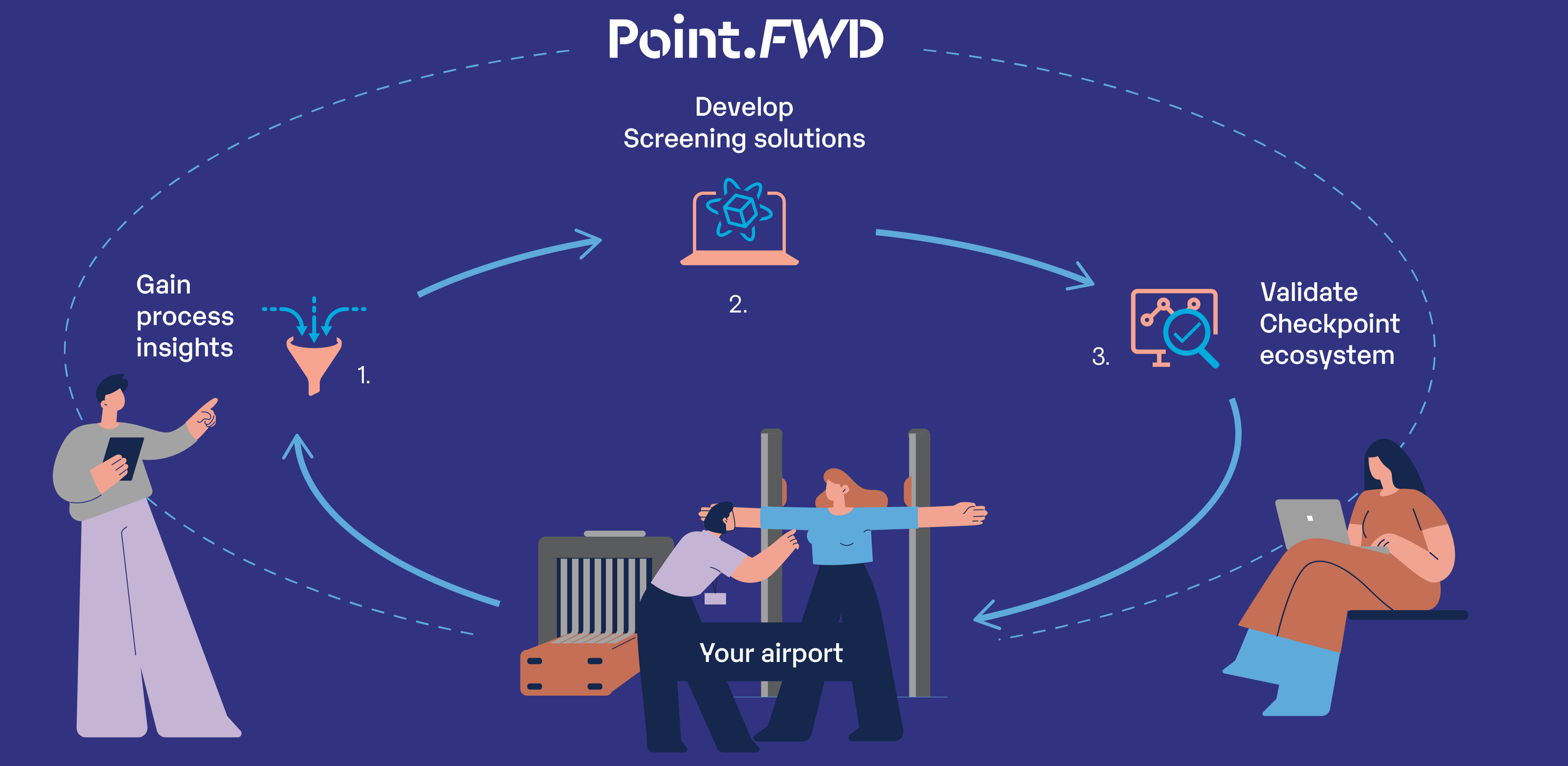
Optimize your security process
Want to see what that looks like in practice? Book a short demo and we will walk you through the platform.