
Why airport security optimization starts with a reliable checkpoint baseline
Why airport security optimization starts with a reliable checkpoint baseline assessment
Why you can’t optimize the unknown
Airport security optimization often starts with a clear ambition: improve throughput, reduce pressure, prepare for growth or make better use of the existing technology. But before an airport can decide what to improve, it first needs to understand how the checkpoint performs today. A reliable security baseline assessment gives that understanding.

Tjeerd van der Meulen
Senior Consultant
Tjeerd@pointfwd.com

Robin van Gemert
Managing Director
Robin@pointfwd.com
Article highlights:
Start with the baseline: Why airport security optimization begins with understanding how the checkpoint performs today, before improvement ideas are tested.
From assumptions to measurable insight: How throughput, divest behavior, staffing levels, decision times and passenger flow become concrete parts of the operation.
Operational understanding on the floor: Why Point FWD combines performance data with observations in the operation and input from security personnel.
Improve across people, process and technology: How a baseline helps prioritize focused training, process improvements, technology adjustments and future lane setup decisions.
Ready to assess your performance baseline?
Request a free 30-minute baseline assessment with one of our senior consultants. We’ll help you assess where to start so your optimizations create meaningful operational value.
Checkpoint improvement from a reliable baseline
Checkpoint optimization often starts with a good idea. A different staffing model, a new lane setup, clearer passenger instructions or a technology change can all feel like logical ways to improve performance. But a good idea still needs to be tested against the reality of the operation: you cannot optimize the unknown.
Many airports know when their checkpoint feels under pressure. Queues build up or staff workload increases. The harder question is where that pressure actually starts. How do passenger profiles, divest behavior, staffing levels and decision times influence performance throughout the day? Questions can easily become assumptions, but when you perform a security baseline assessment, they become measurable parts of the operation.
The Point FWD approach to checkpoint optimization
For Point FWD, optimization starts with operational understanding. We look at the checkpoint as a whole and how it performs in real conditions, across process, people and technology. That means measuring current throughput, identifying bottlenecks, understanding process variation and connecting performance data to what happens on the floor. For us, “on the floor” literally means being in the operation: observing passenger flow, discussing what operators experience during screening, and treating their input as one of the most important sources of operational insight.
From there, we carefully assess what improvements can be made and prioritize them in consultation with the airport. Some changes may be short-term and operational. Others need testing, simulation or a longer-term decision on lane setups, staffing models, CONOPS or technology use. This approach helps airports move from isolated improvement ideas to informed checkpoint decisions.

From baseline assessment to continuous checkpoint improvement
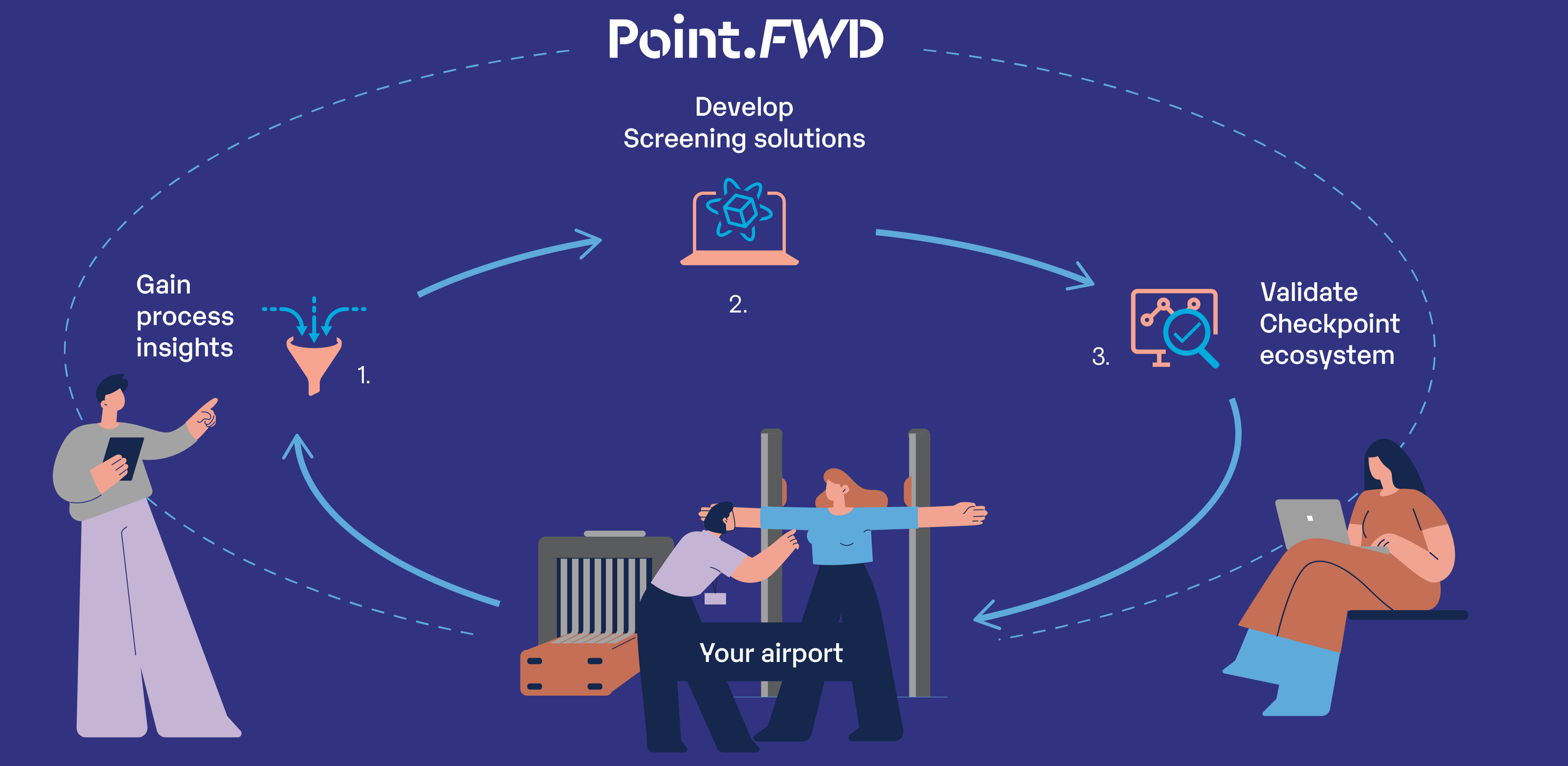
Assessing the current baseline and necessary improvements is only the start. It creates the foundation for testing, validating and implementing those improvements. During and after implementation, performance should be continuously monitored and translated into concrete actions across all three pillars. For the people component, this can translate into focused training when knowledge gaps become visible, for example around how to handle alarms, adapt local procedures or first-line troubleshooting. Process wise, it can mean improving lane planning, passenger distribution towards open divest positions or operator procedures. For technology, sensors could be adjusted, roller speeds sped up or slowed down, specified alarm resolution points or adapting the number of trays in the system to avoid tray starvation.
“You can’t connect the dots looking forward; you can only connect them looking backwards.”
Model, validate and simulate optimizations first
Checkpoint optimization is an ongoing cycle of learning and improving as it becomes visible how passenger flows, processes, staffing and technology interact in the reality of the operation. With the help of AIP (Advanced Insights Platform), we map checkpoint performance, monitor KPIs, identify bottlenecks and use operational data in static modelling to understand the impact of specific process parameters. It turns data into the insight airports need before changing lane setups, staffing models or operational processes.
Optimize your security process
Ready to turn your operational baseline into clear checkpoint improvement opportunities? Book a 30-minute call with Tjeerd van der Meulen and his team to assess your security baseline and optimization opportunities.